
Thomas Ågotnes
Professor, University of Bergen, Norway
Adjunct Professor, Shanxi University, China
Changjiang Scholar Chair Professor
Date: January 8, 2026 (Thursday)
Time: 15:00–17:00
Venue: Zhixin Building, Room A1618
Location: Shandong University, Central Campus
Abstract
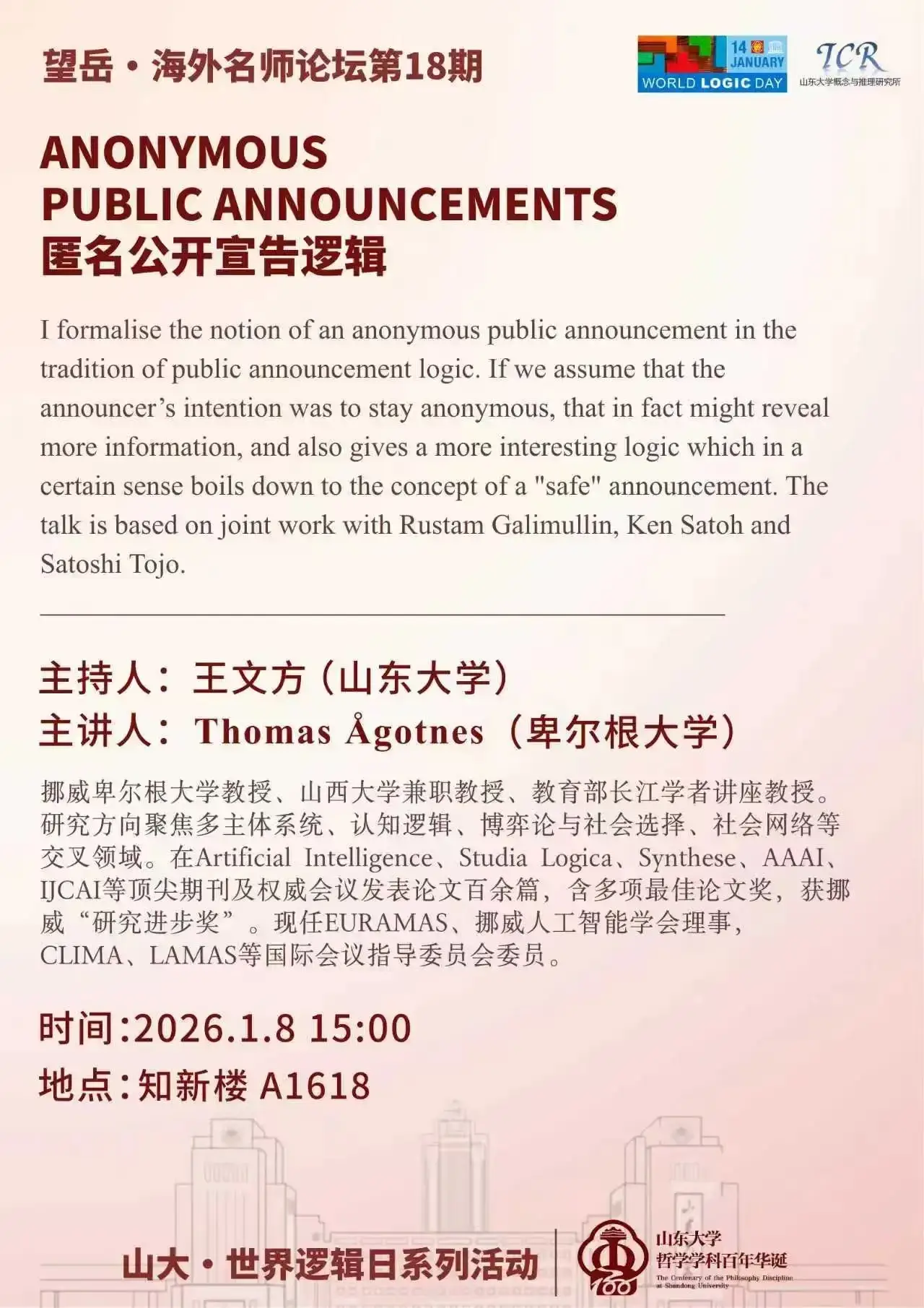
I formalise the notion of an anonymous public announcement in the tradition of public announcement logic. Such announcements can be seen as lying between a public announcement from “the outside” (an announcement of φ) and a public announcement by one of the agents (an announcement of Kaφ): we get more information than just φ, but not necessarily information about exactly who made the announcement. Even if such an announcement is prima facie anonymous, depending on the background knowledge of the agents, it might reveal the identity of the announcer: if I post something on a message board, the information might reveal who I am even if I do not sign my name. Furthermore, as in the Russian Cards puzzle, if we assume that the announcer’s intention was to stay anonymous, that assumption might in fact reveal more information. In this talk, I first look at the case in which no assumptions about intentions are made, in which the logic with an anonymous public announcement operator is reducible to epistemic logic. I then examine the case in which we assume common knowledge of the intention to stay anonymous, which is both more complex and more interesting: in several ways, it boils down to the notion of a “safe” announcement (again, similarly to Russian Cards). The main results include formal expressivity results and axiomatic completeness for key logical languages. The talk is based on joint work with Rustam Galimullin, Ken Satoh, and Satoshi Tojo.
About the Speaker
Thomas Ågotnes is a Professor at the University of Bergen, Norway, an Adjunct Professor at Shanxi University, China, and a Changjiang Scholar Chair Professor under China’s Ministry of Education. His research focuses on interdisciplinary areas including multi-agent systems, epistemic logic, game theory and social choice, and social networks. He has published over 100 research papers in leading journals and conferences, including Artificial Intelligence, Studia Logica, Synthese, AAAI, and IJCAI. He has received multiple best paper awards and a research progress award in Norway. His professional service includes board memberships in EURAMAS and the Norwegian Artificial Intelligence Society, as well as membership on the steering committees of international conferences such as CLIMA and LAMAS.