
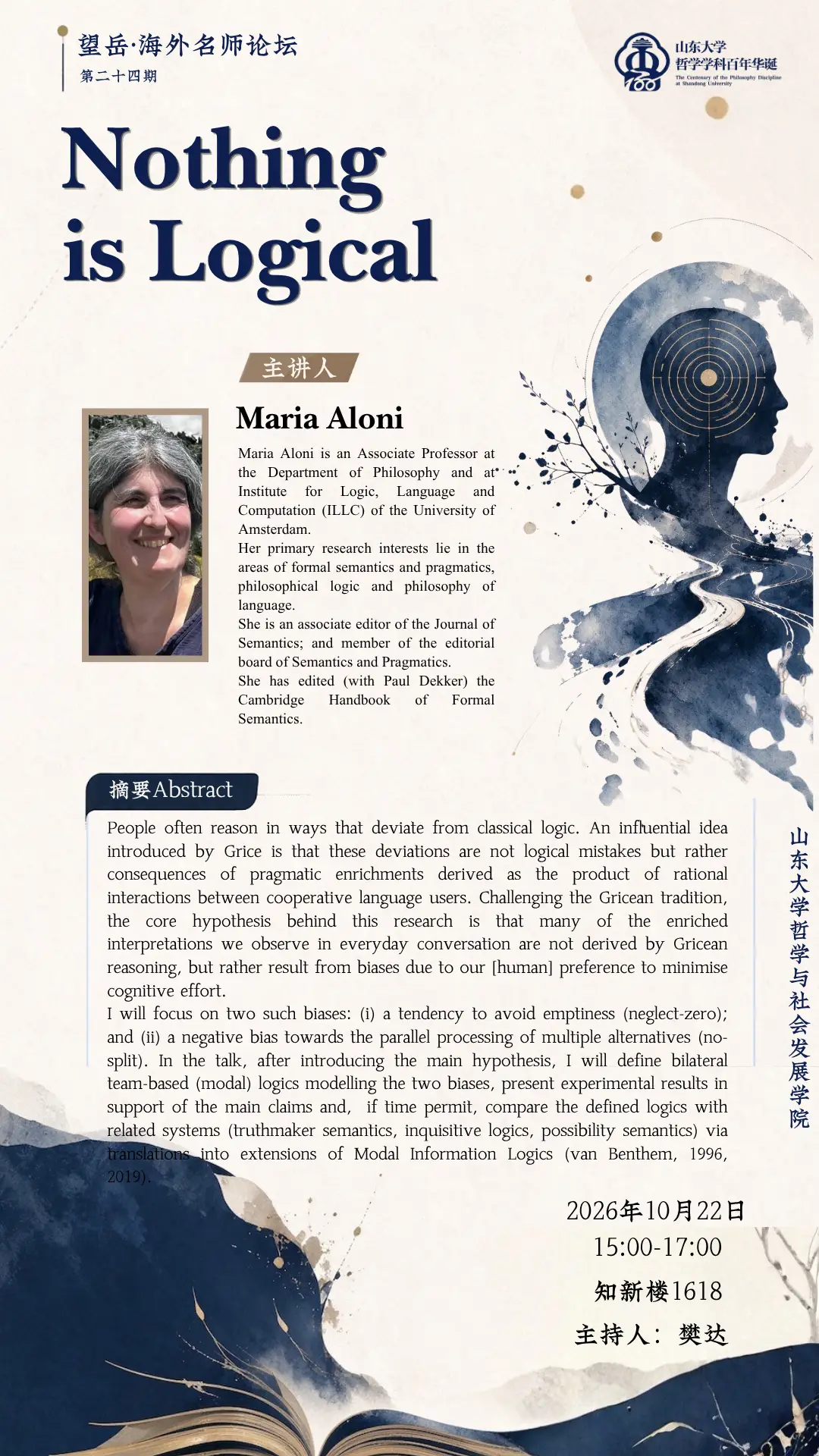
Maria Aloni
Department of Philosophy,
Institute for Logic, Language and Computation (ILLC), University of Amsterdam
Date: October 22, 2026
Time: 15:00–17:00
Venue: Zhixin Building, Room A1618
Location: Shandong University, Central Campus
Abstract
People often reason in ways that deviate from classical logic. An influential idea introduced by Grice is that these deviations are not logical mistakes but rather consequences of pragmatic enrichments derived as the product of rational interactions between cooperative language users. Challenging the Gricean tradition, the core hypothesis behind this research is that many of the enriched interpretations we observe in everyday conversation are not derived by Gricean reasoning, but rather result from biases due to our [human] preference to minimise cognitive effort. I will focus on two such biases: (i) a tendency to avoid emptiness (neglect-zero); and (ii) a negative bias towards the parallel processing of multiple alternatives (no-split). In the talk, after introducing the main hypothesis, I will define bilateral team-based (modal) logics modelling the two biases, present experimental results in support of the main claims and, if time permits, compare the defined logics with related systems (truthmaker semantics, inquisitive logics, possibility semantics) via translations into extensions of Modal Information Logics (van Benthem, 1996, 2019).
About the Speaker
Maria Aloni is an Associate Professor at the Department of Philosophy and at the Institute for Logic, Language and Computation (ILLC) of the University of Amsterdam. Her primary research interests lie in the areas of formal semantics and pragmatics, philosophical logic and philosophy of language. She is an associate editor of the Journal of Semantics and a member of the editorial board of Semantics and Pragmatics. She has edited (with Paul Dekker) The Cambridge Handbook of Formal Semantics.