
Thomas Yee
Associate Professor
Department of Statistics, Faculty of Science
University of Auckland, New Zealand
Date: September 15, 2026 (Tuesday)
Time: 15:00
Venue: Zhixin Building, Room A319
Location: Shandong University, Central Campus
Abstract
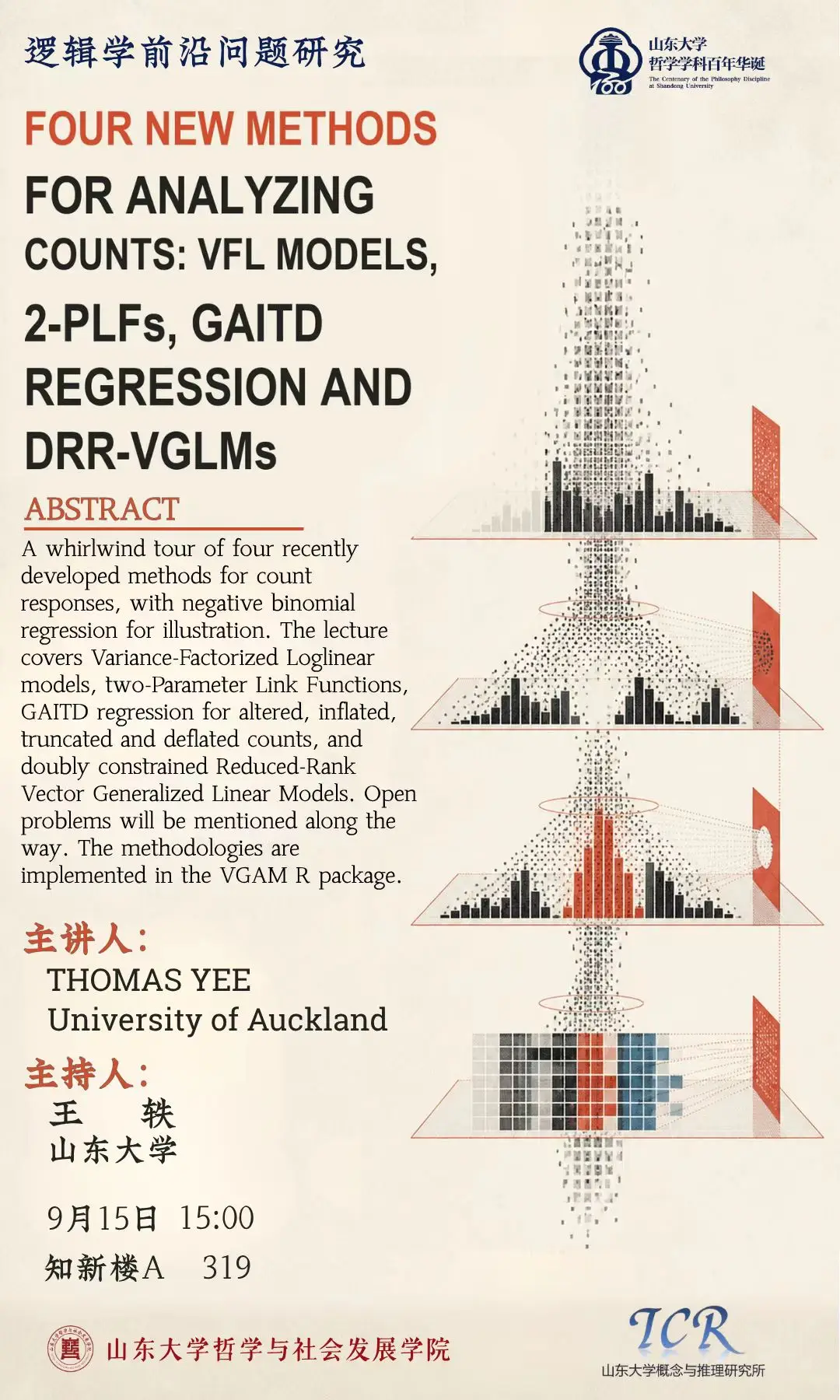
We give a whirlwind tour of four recently developed methods applicable to count responses, using negative binomial (NB) regression for illustration. Variance-Factorized Loglinear (VFL) models allow separate mean-variance quasi-Poisson-like regression based on the NB distribution. In joint work with Victor Miranda, two-Parameter Link Functions (2-PLFs) solve the four-decade-old problem of NB regression with its canonical link. Generally Altered, Inflated, Truncated and Deflated (GAITD) regression is a super-mixture model that jointly combines the four operators. Using the NB as the parent distribution, up to seven modes can be accommodated, as well as underdispersion relative to the Poisson distribution. We direct GAITD regression towards heaped and seeped smoking data. Doubly constrained Reduced-Rank Vector Generalized Linear Models (DRR-VGLMs) provide structure to the two outer-product matrices of RR-VGLMs by way of constraint matrices. Some open problems will be mentioned along the way. The methodologies are implemented in the VGAM R package.
About the Speaker
Thomas Yee is an Associate Professor in the Department of Statistics, Faculty of Science, at the University of Auckland, New Zealand, where he also supervises doctoral students. He received his Ph.D. from the University of Auckland. Following his doctoral studies, he undertook two years of postdoctoral research at the university’s Faculty of Medical and Health Sciences. He subsequently held an academic position in statistics at Massey University’s Albany campus before joining the Department of Statistics at the University of Auckland. His primary research interests include generalized regression, statistical ecology, and computational statistics. He was elected a member of the International Statistical Institute (ISI) in 2014 and served on the board of the Asian Regional Section of the International Association for Statistical Computing (IASC-ARS) from 2017 to 2021. He is also involved in doctoral student affairs and matters relating to health, safety, and well-being within the Department of Statistics at the University of Auckland.