
Patrick Greenough
Senior Researcher
Department of Philosophy
University of St Andrews, UK
Date: June 18, 2026 (Thursday)
Time: 19:00
Venue: Zhixin Building, Room A115
Location: Shandong University, Central Campus
Abstract
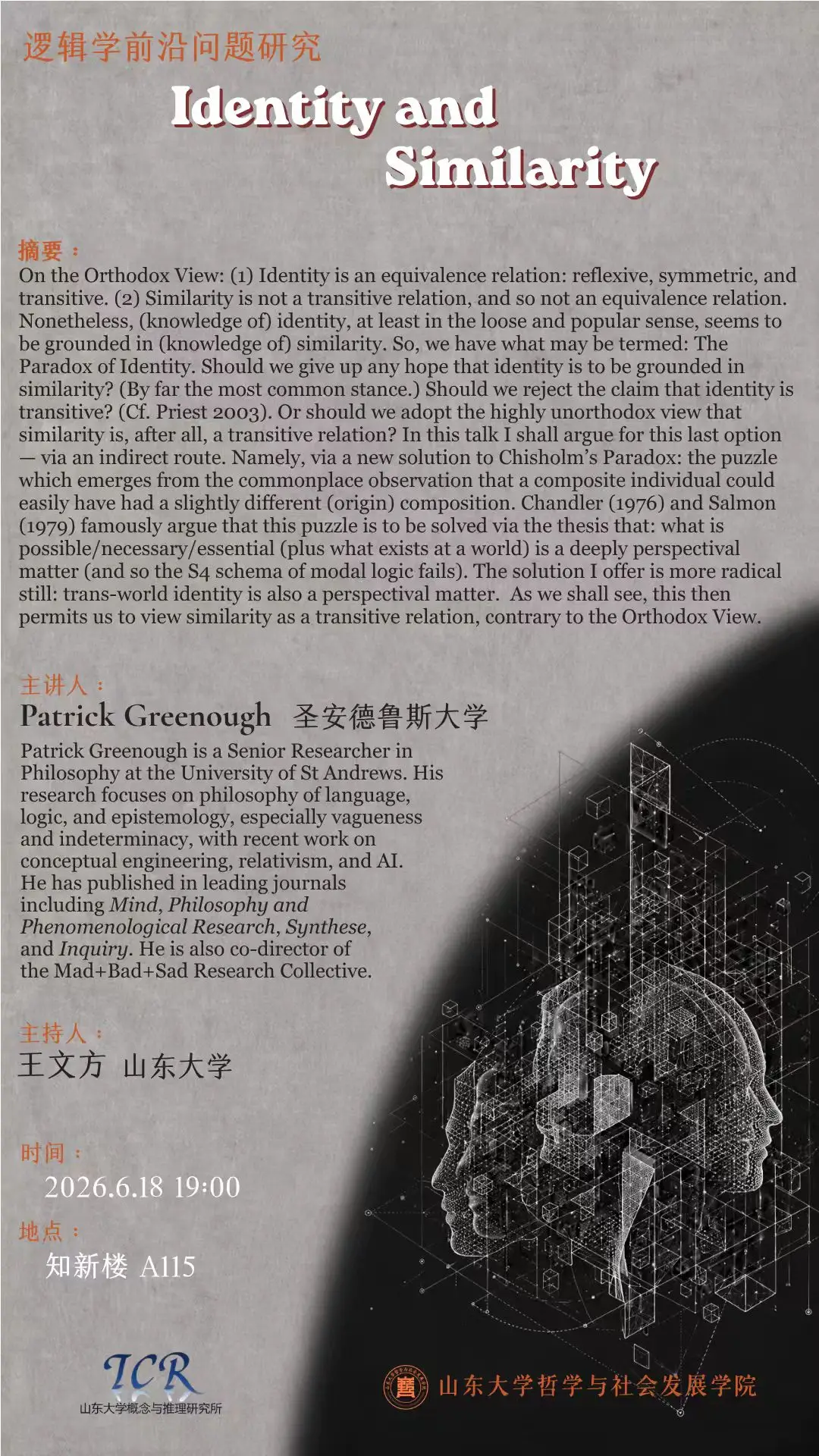
On the Orthodox View: (1) Identity is an equivalence relation: reflexive, symmetric, and transitive. (2) Similarity is not a transitive relation, and so not an equivalence relation. Nonetheless, (knowledge of) identity, at least in the loose and popular sense, seems to be grounded in (knowledge of) similarity. So, we have what may be termed: The Paradox of Identity. Should we give up any hope that identity is to be grounded in similarity? (By far the most common stance.) Should we reject the claim that identity is transitive? (Cf. Priest 2003). Or should we adopt the highly unorthodox view that similarity is, after all, a transitive relation? In this talk I shall argue for this last option—via an indirect route. Namely, via a new solution to Chisholm’s Paradox: the puzzle which emerges from the commonplace observation that a composite individual could easily have had a slightly different (origin) composition. Chandler (1976) and Salmon (1979) famously argue that this puzzle is to be solved via the thesis that: what is possible/necessary/essential (plus what exists at a world) is a deeply perspectival matter (and so the S4 schema of modal logic fails). The solution I offer is more radical still: trans-world identity is also a perspectival matter. As we shall see, this then permits us to view similarity as a transitive relation, contrary to the Orthodox View.
About the Speaker
Patrick Greenough is a Senior Researcher in the Philosophy Department at the University of St Andrews. He has held visiting positions at the Australian National University, the University of Sydney, the University of Oslo, and the University of Connecticut. He works mainly in the philosophy of language, logic, and epistemology, with a particular interest in vagueness and indeterminacy. He has published in leading journals of analytic philosophy, including Mind, Philosophy and Phenomenological Research, Proceedings of the Aristotelian Society, Synthese, and Inquiry. More recently, Patrick has published and given talks on concepts, conceptual engineering, structuralism, relativism, and AI. He is the founder and co-director of a large interdisciplinary research group at the University of St Andrews, the Mad+Bad+Sad Research Collective, which investigates the nature of disability, mental health, and neurodivergence, together with how neurodivergence is central to understanding AI and AGI. His enduring passion is Common Ground Philosophy—finding ways to make progress in philosophy by uncovering the shared commitments among diverse perspectives.