
Special Lecture Series
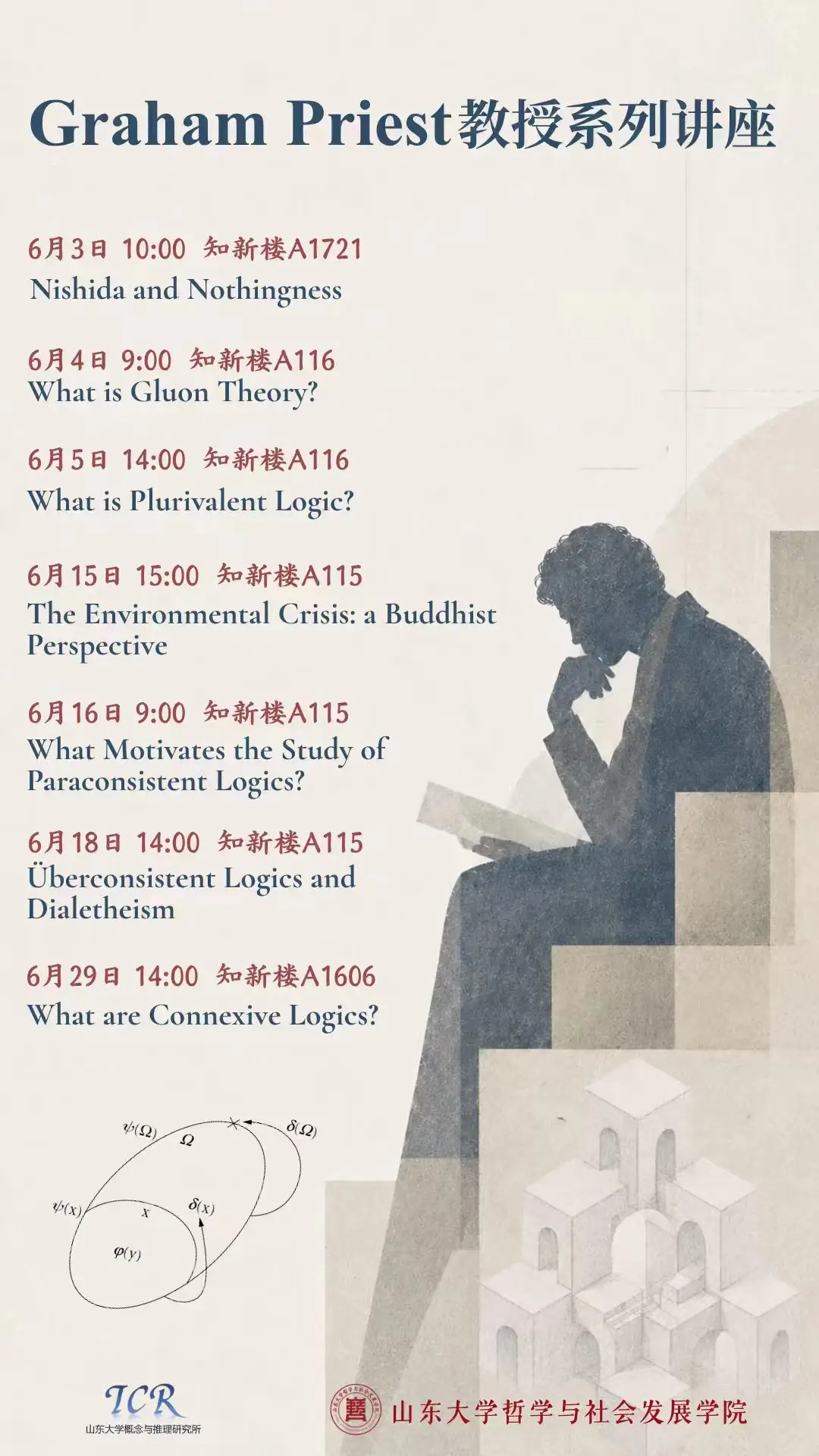
Graham Priest Lecture Series
Speaker: Graham Priest
Series Dates: June 3–29, 2026
Location: Shandong University, Central Campus
About the Speaker
Graham Priest is an internationally renowned philosopher. He received his doctorate from the London School of Economics and is currently Distinguished Professor of Philosophy at the Graduate Center of the City University of New York, Boyce Gibson Professor Emeritus at the University of Melbourne, International Research Fellow at Ruhr University Bochum, Specially Appointed Professor at the Graduate School of Information Sciences of Tohoku University, and Adjunct Chair Professor at Shandong University. His research spans non-classical logic, especially dialetheism, as well as metaphysics, the history of philosophy, and Buddhist philosophy. He is the co-author, with Aaron J. Cotnoir, of Mereology, published by Oxford University Press in 2021. He is also an editor of The Journal of Philosophy, a subject editor for The Stanford Encyclopedia of Philosophy, and an associate or advisory editor of several other philosophical journals and book series.
Lecture Schedule
- Nishida and Nothingness
June 3, 2026 · 10:00 · Zhixin Building, Room A1721 - What is Gluon Theory?
June 4, 2026 · 09:00 · Zhixin Building, Room A116 - What is Plurivalent Logic?
June 5, 2026 · 14:00 · Zhixin Building, Room A116 - The Environmental Crisis: a Buddhist Perspective
June 15, 2026 · 15:00 · Zhixin Building, Room A115 - What Motivates the Study of Paraconsistent Logics?
June 16, 2026 · 09:00 · Zhixin Building, Room A115 - Überconsistent Logics and Dialetheism
June 18, 2026 · 14:00 · Zhixin Building, Room A115 - What are Connexive Logics?
June 29, 2026 · 14:00 · Zhixin Building, Room A1606
Lecture Abstracts
1. Nishida and Nothingness
Date: June 3, 2026 Time: 10:00 Venue: Zhixin Building, Room A1721
Nishida Kitarō (1870–1945) is arguably the most important and influential Japanese philosopher of the twentieth century. Central to his thought was the notion of zettai mu (absolute nothingness). The aim of this talk is to explain and analyse this notion. It is not intelligible without an understanding of some central aspects of the philosophy of Zen Buddhism. In the first part of the talk, I will explain these.
2. What is Gluon Theory?
Date: June 4, 2026 Time: 09:00 Venue: Zhixin Building, Room A116
Gluon theory is a technical and philosophical theory developed in my book One (Oxford University Press, 2018). It was developed to address the problem of how the parts of an object can constitute a unity. It uses the techniques of paraconsistent logic and a non-transitive account of identity. In this talk I will explain its basic idea and some of its applications.
3. What is Plurivalent Logic?
Date: June 5, 2026 Time: 14:00 Venue: Zhixin Building, Room A116
Plurivalency is a technique that allows a formula in a many-valued logic to have more than one of the many values. In this talk I will describe the basic construction, some of its features, and, if there is time, some of its applications.
4. The Environmental Crisis: a Buddhist Perspective
Date: June 15, 2026 Time: 15:00 Venue: Zhixin Building, Room A115
It is no secret that the world is facing an environmental crisis due to global warming. Why should one care? And what should we do? These are questions that concern any thoughtful person. The answer to them depends, of course, on one’s philosophical views—most crucially, ethical and political. In this talk I will provide an answer to these questions from the perspective of Buddhist philosophy. No prior knowledge of Buddhist thought will be presumed.
5. What Motivates the Study of Paraconsistent Logics?
Date: June 16, 2026 Time: 09:00 Venue: Zhixin Building, Room A115
Paraconsistent logics are logics in which contradictions do not imply everything. These logics have been studied intensively for some seventy years. Such studies have been motivated by a wide variety of philosophical considerations. In this talk I will explain and discuss some of them.
6. Überconsistent Logics and Dialetheism
Date: June 18, 2026 Time: 14:00 Venue: Zhixin Building, Room A115
For many decades, logics that permit inconsistent but non-trivial theories have been investigated and discussed. See, for example, Priest, Tanaka, and Weber (2022). However, in recent years we have seen the recognition that there are logics which not only permit contradictions, but which deliver contradictions: the logical truths are themselves inconsistent. As yet, they have no standard name. I will call them Überconsistent logics. Dialetheism is the view that some contradictions are true. It might well be thought that these logics, which deliver contradictory logical truths, provide an open-and-shut case for dialetheism. After all, as Quine puts it, “if sheer logic is not conclusive, what is?” (Quine 1997, p. 81). Matters are not that straightforward, however. This talk is an investigation of the relationship between Überconsistent logics and dialetheism. The investigation is a provisional and preliminary one.
7. What are Connexive Logics?
Date: June 29, 2026 Time: 14:00 Venue: Zhixin Building, Room A1606
Connexive logics are logics which validate principles such as:
- Aristotle: ¬(A → ¬A)
- Boethius: A → B ⊢ ¬(A → ¬B)
These principles were standard in Ancient and Early Medieval Western logic, but fell out of favour due to their tendency to deliver contradiction. However, in the last fifty years or so, logicians have started to investigate formal connexive logics and their properties. This talk will be devoted to an introduction to such logics.